


Freeze-drying, also known as lyophilization, is a sophisticated food preservation technique that removes moisture from fruit while preserving its nutritional value, flavor, and natural color. As a professional freeze-dried fruit manufacturer with eight advanced production lines and an annual output of 100 tons, we utilize this process to deliver high-quality products from over 100 different types of fruit. This article will guide you through the detailed steps of the industrial freeze-drying process.

The Key Stages of Freeze-Drying Fruit
The entire freeze-drying process consists of three primary phases: freezing, primary drying (sublimation), and secondary drying (desorption). Each stage is critical to ensuring the final product's superior quality, texture, and shelf life.
1. Selection and Preparation
Before the freeze-drying begins, raw fruits are meticulously selected based on strict quality criteria. They are then washed, sorted, and often sliced or diced into uniform pieces. This preparation is vital for ensuring consistent drying results across the batch.
2. Freezing
The prepared fruit is placed on trays and loaded into the freeze-drying chamber. The temperature is rapidly lowered to well below freezing, typically between -30°C and -50°C (-22°F to -58°F). This quick freezing solidifies the water content within the fruit into ice crystals. The speed and temperature are controlled to form small crystals, which help protect the fruit's cellular structure and prevent damage.
3. Primary Drying (Sublimation)
Once the fruit is completely frozen, the primary drying phase begins. The pressure inside the freeze-drying chamber is drastically reduced to create a vacuum. Then, slight heat is applied. Under this low pressure, the frozen water crystals sublimate-meaning they transition directly from a solid state into a vapor, bypassing the liquid phase entirely. This process slowly removes the vast majority of the moisture from the fruit.

4. Secondary Drying (Desorption)
After sublimation, a small amount of moisture remains bound to the fruit's cellular structure. The secondary drying phase removes this residual water. The temperature is gradually increased to higher levels (but still below the fruit's cooking point), and the vacuum is maintained. This process, called desorption, ensures the fruit is thoroughly dry, achieving a moisture content of typically 1-2%. This extremely low moisture level is what gives freeze-dried fruit its characteristic crisp texture and long shelf life without the need for preservatives.
5. Packaging and Storage
The final step involves promptly packaging the freeze-dried fruit in moisture-resistant and airtight packaging. This is crucial to protect the hygroscopic product from absorbing ambient moisture from the air, which would compromise its texture and stability. Properly packaged, freeze-dried fruit can be stored for years without refrigeration.
Why Choose Freeze-Drying?
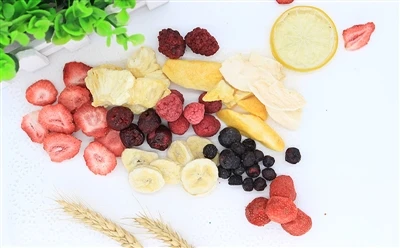
The freeze-drying process offers unparalleled advantages:
Nutrient Retention: It preserves the nutritional profile, including heat-sensitive vitamins and antioxidants, far better than other drying methods.
Flavor and Color: The natural flavor and color of the fruit are concentrated and maintained.
Texture: It creates a light, crispy texture that rehydrates quickly.
Lightweight and Shelf-Stable: The removal of water significantly reduces weight and makes the product shelf-stable.
As experts in the field, we leverage our eight state-of-the-art freeze-drying production lines to perfect this complex process for over 100 varieties of fruit, ensuring we meet the highest standards of quality and food safety in every 100-ton batch we produce. Freeze-dried fruit is not just a snack; it's a testament to modern food science preserving nature's best offerings.
